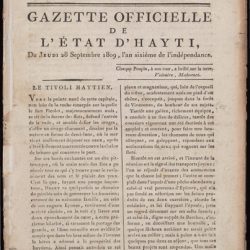
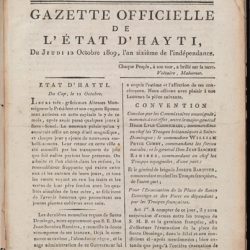
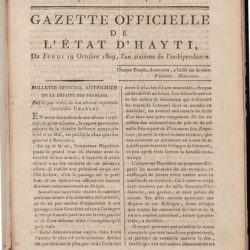
2 Novembre 1809

Reporting at the outset the United States’s lifting of the embargo against trading with England (excerpted from L’Ambigu), this issue also announces the new administration’s desire, led by President James Monroe, to “re-establish with Great Britain a complete and friendly relationship.” France’s reaction to this entente and news of Austria’s ongoing conflict with France round out the issue.

9 Novembre 1809

This issue begins with an excerpt from L’Ambigu detailing Napoleon Bonaparte’s defeat of the Hungarians at Raab in July 1809. These victorious moments in Bonaparte’s military career were clearly causing great consternation in England, and the article calls for Russia to soundly defeat the French emperor, who at the time was proclaimed to be “invincible” across Europe.  A rhyming enigma concludes the issue, with its answer to be published in the subsequent week’s newspaper.

16 Novembre 1809

The answer to the riddle or enigma published in the last issue is revealed here to be “Friendship.” Perhaps, more importantly, however, Napoleon Bonaparte’s defeat of the Papal States is announced as a “monstrous usurpation.” Indeed, these actions would lead Bonaparte to be ex-communicated by the Catholic Church. A report on the comings and goings of foreign ships at the port of Cap-Haïtien concludes issue number 46.

23 Novembre 1809

The issue begins by announcing Napoleon Bonaparte’s ex-communication from the Catholic Church, per the orders of Pope Pius VII. Because the pope had himself been captured and jailed by French forces, this papal decree is simultaneously acknowledged to be “powerless,” however. In happier news emanating from the State of Hayti itself, the arrival of British Vice-Admiral Thomas Goodall in a frigate called, “L’Haytienne,” is reported. Goodall, called a “brave mariner, whose devotion and service to our cause makes him worthy of such a title,” evidently attended a celebration at the palace given in his honor. 

30 Novembre 1809

Returning to its focus on exposing the so-called crimes of Pétion’s rival government in Port-au-Prince, this issue finishes with an acrostic poem spelling the last name of the poet and dramaturge, Antoine Dupré. Far from being an homage, the poem represents an attack on the character of this poet from the southern republic of Haiti, who is most well known for his celebrated poem, “Hymne à la Liberté” and his two no longer extant plays, Les Jeunes filles and La Mort de général Lamarre.

7 Décembre 1809

Continuing with its attack on both Antoine Dupré and rival president Alexandre Pétion, this issue quotes Father Corneille Brelle as stating that the country of Haiti has “only one leader,” Henry Christophe, and only one prefect, Brelle himself. This last point was a jab at the curé of the southern republic, P. J. B. Jh Lemaire, who had evidently issued a “pastoral invitation” to the inhabitants of the northern state of Haiti.

14 Juin 1810

One of the most noteworthy elements of this issue is the change of the long-standing epigraph from Voltaire’s play, Mahomet, to a citation from the celebrated French abolitionist, the abbé Henri Grégoire’s De la Littérature des Nègres (1808). The powerful quote preceding the issue now reads, “The friends of slavery are necessarily the enemies of humanity.” The editor of the Gazette, Juste Chanlatte, was a known admirer of Grégoire’s 1808 celebration of black writing. This is demonstrated by the fact that Chanlatte dedicated his 1810 history of the new nation to Grégoire, even mentioning it in the title of the publication itself: Le Cri de la nature, ou, Hommage haytien au très-vénérable abbé H. Grégoire, auteur d’un ouvrage nouveau, intitulé De la littérature des Nègres, ou, Recherches sur leurs facultés individuelles, leurs qualités morales et leur littérature ; suivies de notices sur la vie et les ouvrages des Négres.

3 Janvier 1811

One of only three issues of La Gazette Officielle from 1811 that appears on this site, these publications record some of the last days of Christophe’s presidency, as he prepared to declare a monarchy in March 1811. Importantly, we observe that the epigraph has once again changed. The citation is now from Voltaire’s 1760 heroic tragedy, Tancrède. The quote reads (which I have translated into English): “Friends! Let there be only one party among us; that of the public good and the safety of all!”

10 Janvier 1811

The first part of the celebration of the eighth anniversary of Haitian independence takes over this entire issue. At the end of the narration, we learn that the Haitian citizens are asked to collectively “swear to renounce France forever and to die rather than to live under its domination,” as well as to “shed their blood until the last drop for the liberty and independence of our country.” The oath was “solemnly repeated” by all in attendance, according to the article, until all the voices merged into one, ending with the citizenry lifting their hands up to the sky “to attest to the importance and inviolability” of this ritual.

17 Janvier 1811

It is perhaps fitting that the final known known extant issue of La Gazette Officielle begins by recounting the end of a celebration held in honor of the eighth anniversary of Haitian independence. Among those toasted were President Henry Christophe, naturally, along with the abbé Grégoire, referred to as “the friend of humanity,” Father Corneille Brelle, the future Queen, Marie-Louise, and the “Marines of Haiti,” for their “continued success.”

22 Juillet 1813

The fact that we have no known issues of the northern government’s newspaper dating from the time Christophe established his monarchy in March 1811 until July 1813, makes it difficult to speculate about when or why the epigraph might have changed to a quotation from Voltaire’s final play, Tancrède, to his 1742 tragedy, Mérope. The new epigraph reads in English translation, “The first to be king was a happy soldier/Who serves his country well does not need elders.” The first article of this issue describes “melodious songs and music” that accompanied the”fête” of King Henry Christophe, which had been celebrated yearly on the 15th of July, beginning in 1807.

26 Juillet 1813

This entire issue describes the “fête” of the Royal Prince, Victor Henry, which was celebrated on the 20th of July 1813, evidently, the day before his actual birthday. Baron de Vastey, who was the young prince’s tutor at one point, dedicated his 1817 Réflexions politiques sur quelques ouvrages et journaux francais concernant Hayti, to “his royal highness, Monseigneur, le prince, Victor Henry.” In the Réflexions Vastey also tells the sad tale of Christophe’s eldest son, François Ferdinand, who had been sent to France at the age of nine to be educated at the Lycée of M. Coignon (where Toussaint Louverture’s sons attended as well). Vastey reports, however, that Prince Ferdinand died in La Maison des Orphelins on October 5, 1805.  Because all of Christophe’s older sons passed away before he assumed governance of the north of Haiti, Victor Henry was the heir apparent.

5 Janvier 1814

One of the longest issues in our collection, with eight pages, the first of the La Gazette to appear in 1814 continues the long tradition of describing the festivities involved in celebrating Haitian Independence Day. The commemoration of the eleventh year of Haitian independence began with the usual speeches, spoken in front of a huge crowd in the city of Sans-Souci, the future site of the king’s new palace. In addition to Christophe, the queen, the prince, and the princesses, who were all in attendance, Baron de Vastey gave a speech on the king’s behalf in which he declared, “the founding of a monarchy has opened our hearts once again to hope, and foretells for Haitians a new and more glorious destiny.”

27 Janvier 1814

One thing readers may immediately observe is the irregularity with which La Gazette is now published. Today’s issue is number 2 in sequence, but appearing several weeks after issue 1. We observe also that the newspaper is no longer published only on Thursdays, as this issue appeared on a Wednesday. Nevertheless, there is much here that remains the same, as we continue to have lengthy reports of festivities, parades, and lavish dinners at the king’s palace. Notably, Richard the Lion-Hearted, the famous opera of Belgian composer, André Gétry, was performed for the festival of the king on the 6th of the month. One imagines that this was a very suggestive performance, since the opera dramatizes the legend of King Richard the first of England’s capture by the archduke of Austria, and naturally, his eventual release. There is repeated mention here as well of a massacre that occurred near the river that borders the Bay of Mancenille, and of Spanish participation in the festivities here described. Finally, at the end there is talk of the new palace, which although described as still being under construction, is promised to be “magnificent.”
To find out more about an issue, see this related post.

30 Avril 1814

The first article of this issue is focused on Haiti’s robust trade, briefly, but proudly, describing the movement and ships in and out of its harbors. The rest of the issue is devoted to describing the funeral of the Comte du Borgne, lieutenant general of the army of the king and deputy governor of the city of Sans-Souci. The Comte de Saint-Louis, a lieutenant general himself, gave a moving elegy after the blessing of the clergy, in which he stated of the deceased, “Dear and intrepid shadow of this estimable soldier whom we mourn…accept these vows, these homages, which we owe to your virtues.”

16 Août 1814

This issue rather gleefully announces the restoration of the Bourbon Monarchy, not because the government of Christophe was particularly fond of the Bourbons, but rather because Emperor Napoleon Bonaparte had been at last dethroned. The following statement provides a glimpse of the tenor of the rest of the report: “Our implacable enemy is no more; the execrable Bonaparte, who had vainly tried to exterminate us, has just succumbed to the united efforts of the Allied Powers. As happy as we are now, Europe has just broken his tyrannical yoke forever.”

19 Novembre 1814

Readers will notice with this issue that the epigraph of La Gazette Royale has once again changed. Fascinatingly, the quote now used is not attributed to any particular individual and reads: “Friends! when you hear the words Slave and Master, let nothing stop the wrath that ignites us, the bell of liberty has been rung! run to your weapons, to fire, to carnage, and to vengeance!” However, further examination of the present issue reveals that these are the words of Baron de Vastey, given in a speech after the capture of the French spy, Agoustine Franco de Médina. Franco de Médina had been sent to the northern part of Haiti in the summer of 1814 by the French Minister of the Marine, Baron de Malouet, in order to spy on the northern kingdom of Haiti with the hopes of restoring the former colony to French rule.

Almanach Royal D’Hayti – 1814

The first issue of the Almanach Royal was published some time in 1813 by the state-run printer, P. Roux. The year 1814 that appears on the cover of this issue was an important one in Haiti, as it marked not only the publication of Baron de Vastey’s Le système colonial dévoilé, but it was also the year that a treaty of peace was struck after years of civil war between Henry Christophe and Alexandre Pétion, the president of the southern Republic of Haiti, seated in Port-au-Prince.

17 Avril 1815

Importantly, this issue contains a reprint of an article from Peltier’s L’Ambigu, which itself had printed a letter written by Louis XVIII, originally published in January in the Moniteur de la France. In the letter the French monarch  disavows and condemns the ill-fated mission of Dauxion Lavaysse, the French spy sent to Haiti on the orders of the French Minister of the Marine, Baron de Malouet, at the beginning of the Bourbon Restoration in the summer of 1814. Even while still insisting that the original intentions of the mission had been “peaceful,” the French king unequivocally declared that Lavaysse had not “been authorized to transmit communications that were contrary to this mission.” 

Get in Touch

Comments? Questions? Found an early Haitian newspaper that you’d like to share?

Office

Yale University

203-432-6086

Social