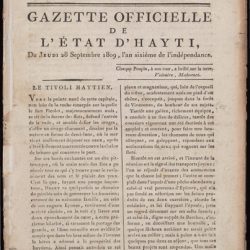
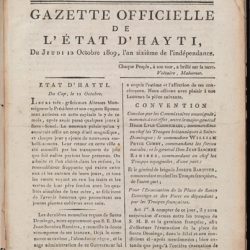
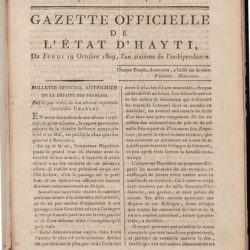
26 Octobre 1809

This issue begins with a proclamation issued by President Christophe to those blockaded in Môle Saint-Nicholas as a result of the civil war with the southern republic of Haiti. With this proclamation, Christophe offers amnesty to all the cultivators, citizens, and military officers of any rank, be they men or women, in exchange for an “apology for their mistakes” and their “return to duty.” The apostolic prefect of Haiti, Father Corneille Brelle’s addresses follows that of Christophe. Brelle, too, encourages those currently under blockade to take advantage of the amnesty offered to them by “the good president Henry Christophe, the good father of Haiti.”

2 Novembre 1809

Reporting at the outset the United States’s lifting of the embargo against trading with England (excerpted from L’Ambigu), this issue also announces the new administration’s desire, led by President James Monroe, to “re-establish with Great Britain a complete and friendly relationship.” France’s reaction to this entente and news of Austria’s ongoing conflict with France round out the issue.

9 Novembre 1809

This issue begins with an excerpt from L’Ambigu detailing Napoleon Bonaparte’s defeat of the Hungarians at Raab in July 1809. These victorious moments in Bonaparte’s military career were clearly causing great consternation in England, and the article calls for Russia to soundly defeat the French emperor, who at the time was proclaimed to be “invincible” across Europe.  A rhyming enigma concludes the issue, with its answer to be published in the subsequent week’s newspaper.

16 Novembre 1809

The answer to the riddle or enigma published in the last issue is revealed here to be “Friendship.” Perhaps, more importantly, however, Napoleon Bonaparte’s defeat of the Papal States is announced as a “monstrous usurpation.” Indeed, these actions would lead Bonaparte to be ex-communicated by the Catholic Church. A report on the comings and goings of foreign ships at the port of Cap-Haïtien concludes issue number 46.

23 Novembre 1809

The issue begins by announcing Napoleon Bonaparte’s ex-communication from the Catholic Church, per the orders of Pope Pius VII. Because the pope had himself been captured and jailed by French forces, this papal decree is simultaneously acknowledged to be “powerless,” however. In happier news emanating from the State of Hayti itself, the arrival of British Vice-Admiral Thomas Goodall in a frigate called, “L’Haytienne,” is reported. Goodall, called a “brave mariner, whose devotion and service to our cause makes him worthy of such a title,” evidently attended a celebration at the palace given in his honor. 

30 Novembre 1809

Returning to its focus on exposing the so-called crimes of Pétion’s rival government in Port-au-Prince, this issue finishes with an acrostic poem spelling the last name of the poet and dramaturge, Antoine Dupré. Far from being an homage, the poem represents an attack on the character of this poet from the southern republic of Haiti, who is most well known for his celebrated poem, “Hymne à la Liberté” and his two no longer extant plays, Les Jeunes filles and La Mort de général Lamarre.

7 Décembre 1809

Continuing with its attack on both Antoine Dupré and rival president Alexandre Pétion, this issue quotes Father Corneille Brelle as stating that the country of Haiti has “only one leader,” Henry Christophe, and only one prefect, Brelle himself. This last point was a jab at the curé of the southern republic, P. J. B. Jh Lemaire, who had evidently issued a “pastoral invitation” to the inhabitants of the northern state of Haiti.

14 Juin 1810

One of the most noteworthy elements of this issue is the change of the long-standing epigraph from Voltaire’s play, Mahomet, to a citation from the celebrated French abolitionist, the abbé Henri Grégoire’s De la Littérature des Nègres (1808). The powerful quote preceding the issue now reads, “The friends of slavery are necessarily the enemies of humanity.” The editor of the Gazette, Juste Chanlatte, was a known admirer of Grégoire’s 1808 celebration of black writing. This is demonstrated by the fact that Chanlatte dedicated his 1810 history of the new nation to Grégoire, even mentioning it in the title of the publication itself: Le Cri de la nature, ou, Hommage haytien au très-vénérable abbé H. Grégoire, auteur d’un ouvrage nouveau, intitulé De la littérature des Nègres, ou, Recherches sur leurs facultés individuelles, leurs qualités morales et leur littérature ; suivies de notices sur la vie et les ouvrages des Négres.

3 Janvier 1811

One of only three issues of La Gazette Officielle from 1811 that appears on this site, these publications record some of the last days of Christophe’s presidency, as he prepared to declare a monarchy in March 1811. Importantly, we observe that the epigraph has once again changed. The citation is now from Voltaire’s 1760 heroic tragedy, Tancrède. The quote reads (which I have translated into English): “Friends! Let there be only one party among us; that of the public good and the safety of all!”

10 Janvier 1811

The first part of the celebration of the eighth anniversary of Haitian independence takes over this entire issue. At the end of the narration, we learn that the Haitian citizens are asked to collectively “swear to renounce France forever and to die rather than to live under its domination,” as well as to “shed their blood until the last drop for the liberty and independence of our country.” The oath was “solemnly repeated” by all in attendance, according to the article, until all the voices merged into one, ending with the citizenry lifting their hands up to the sky “to attest to the importance and inviolability” of this ritual.

17 Janvier 1811

It is perhaps fitting that the final known known extant issue of La Gazette Officielle begins by recounting the end of a celebration held in honor of the eighth anniversary of Haitian independence. Among those toasted were President Henry Christophe, naturally, along with the abbé Grégoire, referred to as “the friend of humanity,” Father Corneille Brelle, the future Queen, Marie-Louise, and the “Marines of Haiti,” for their “continued success.”

Get in Touch

Comments? Questions? Found an early Haitian newspaper that you’d like to share?

Office

Yale University

203-432-6086

Social